North Line Gaming · Hands-on review
Geometry Rift: Apocalypse hands-on: The minigame that got out of hand
A father-and-son team turned a tiny Geometry Wars tribute into one of the most polished indie demos we've played this year, though a few unfair hits still need fixing.
The early verdict
Geometry Rift: Apocalypse was never meant to be a game of its own. It began as a minigame on a vintage terminal inside Still Breathing, the bunker game that Víctor and his son Álex have been building for years. Having spent a good few evenings with the Steam demo, I'm glad it got out of hand. It's polished, has a strong "one more run" pull, and holds its own next to the games that inspired it. A few cheap hits still need fixing before launch.
Origins
From terminal minigame to its own game
One of the games on that Still Breathing terminal was a small tribute to Geometry Wars. "I'd always wanted to make something as beautiful as that game," Víctor told us, "so I thought: what if I tried making it a separate game?"
His first idea was simple: Vampire Survivors with the look of Geometry Wars. It didn't quite work. "Playing it felt a bit dull; the speed of a spaceship didn't really work with those hordes."
So the two of them started reworking the mechanics and progression. "Little by little, it stopped being that mix and started having its own personality," Álex says. "And, well, the minigame got a little out of hand, haha."
The division of labour is simple. Víctor handles the technical side, graphics, effects and music, drawing on "my whole life doing design, animation and computer music." Álex owns the design and feel: "I prefer thinking about how the game plays, testing things, changing what doesn't work, and working on stories and characters." He's also the reality check: "My dad tends to get excited about whatever he's just made, and I'm the one who comes along with 'yes, but this...'"
You can feel that tension in the game. It has a designer's love of spectacle and a playtester's eye for what works, and occasionally the spectacle wins.
First impressions
Polish you don't expect from a two-person team
The first thing I noticed wasn't the gameplay. It was the music. A track builds as the main menu loads, and it immediately feels high-end. Throughout the menus, the art style is consistent, everything responds quickly, and nothing looks thrown together.
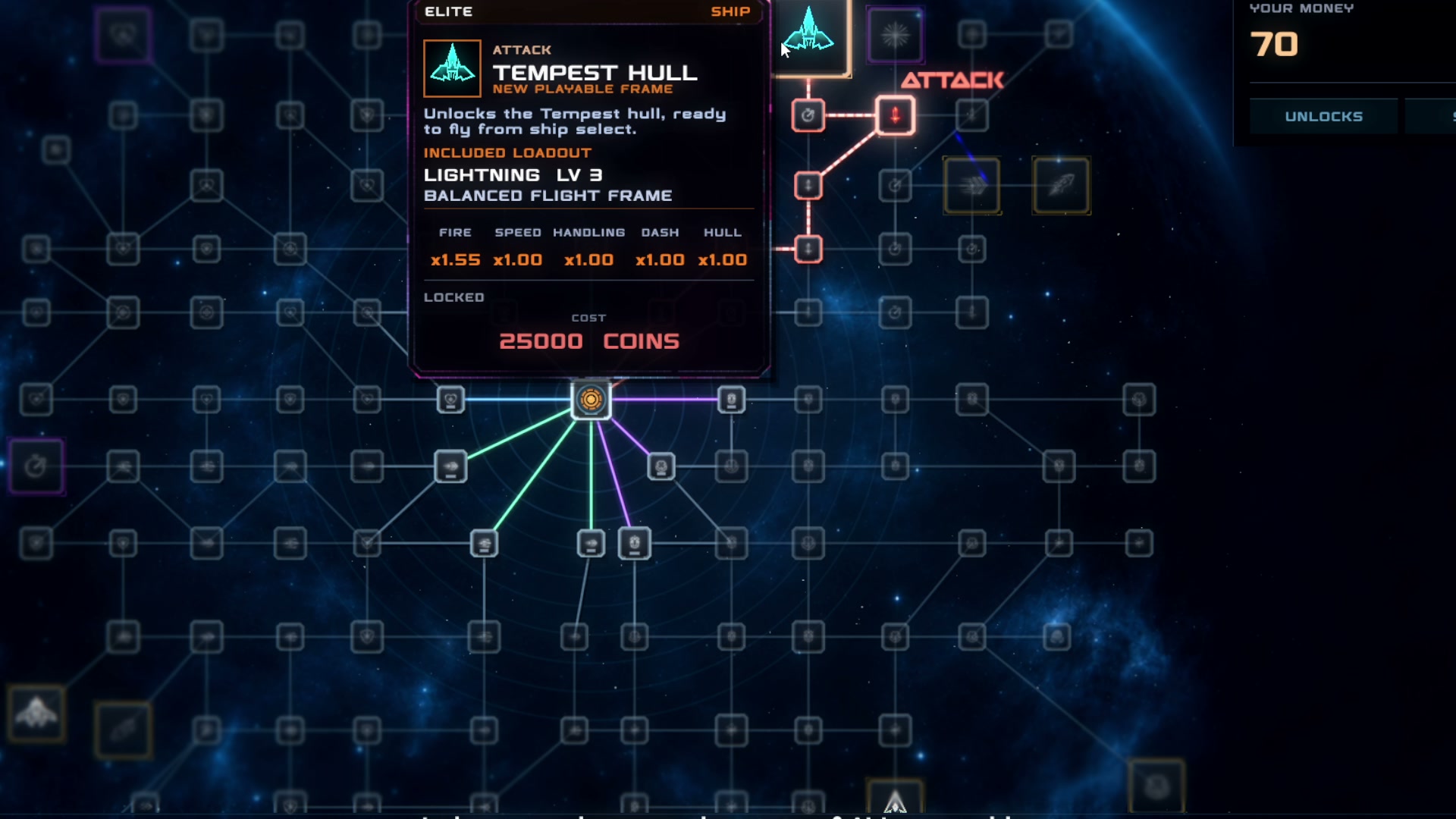
The first run starts simple: a small ship in a neon arena shooting at geometric shapes. The complexity builds gradually. Weapons, upgrades, ship choices and meta-progression come in a few at a time until you realise the game is much deeper than its first five minutes suggest. Nothing confused me early on, which is a quiet achievement for this genre.
If I had to sum it up for a friend: it's Vampire Survivors in geometric space. That undersells it a little, though.
Visuals
Neon, chaos, and finding your ship
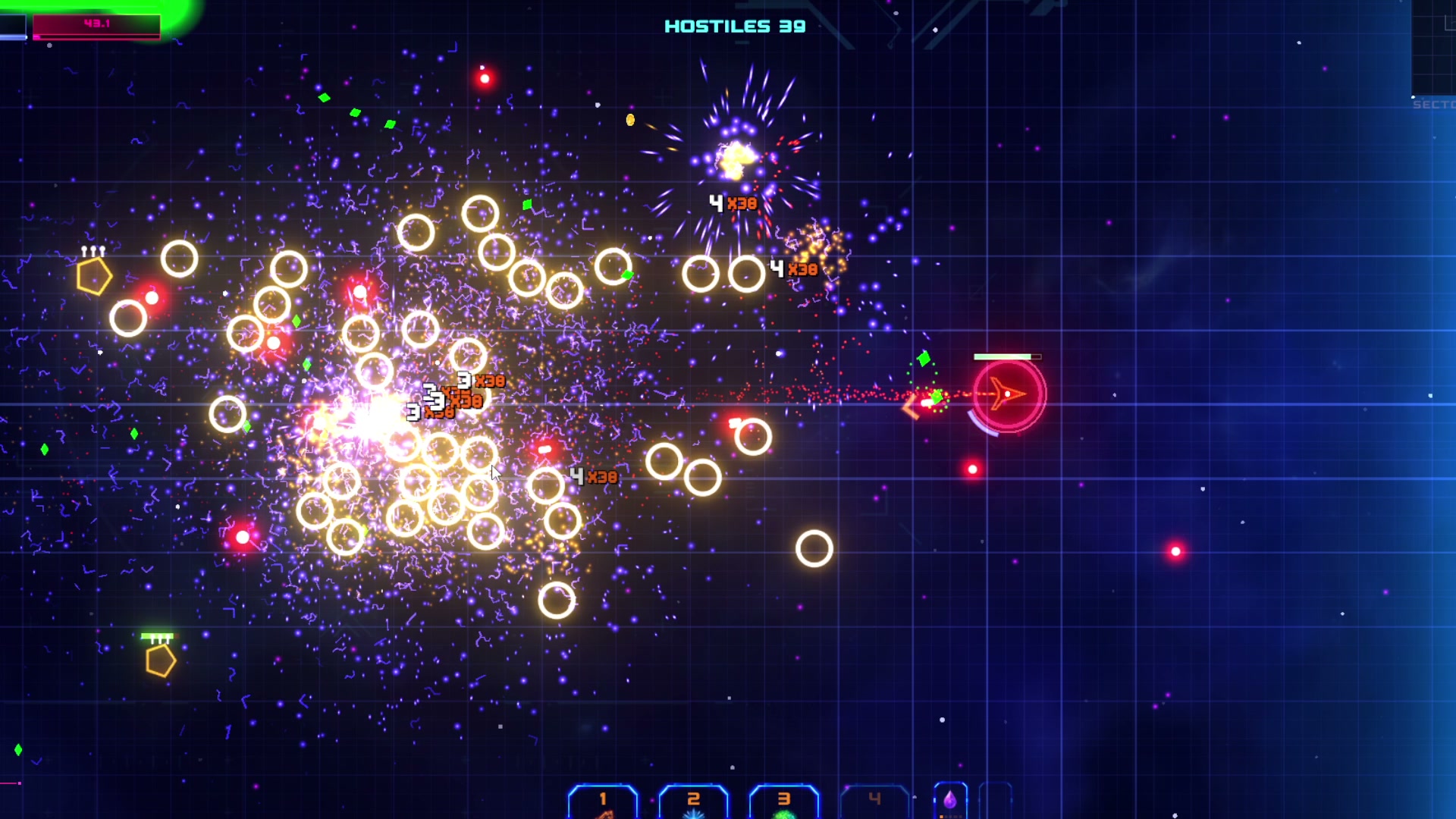
The neon look is a great choice, and the game is lovely to watch in motion. Víctor freely admits he loves "filling the screen with neon, explosions and thousands of little pieces," and the team clearly worked hard to keep it readable. One clever fix detects when the brightness under your ship goes above a certain level, then draws a strong shadow in the ship's colour over it. "It's not the most elegant solution in the world," Víctor says, "but it lets you find your ship in the middle of the chaos."
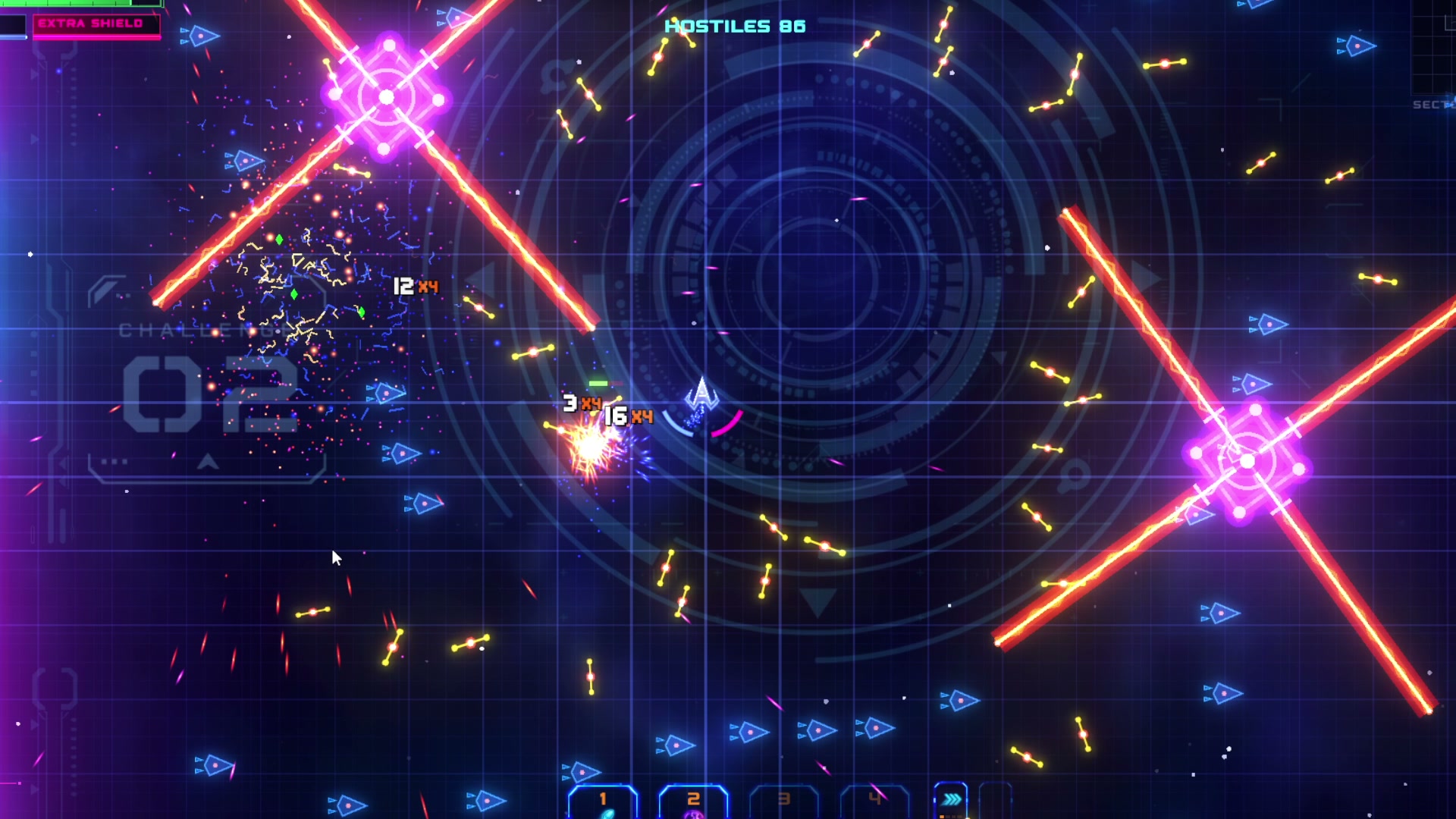
It mostly works, but not always. In the busiest moments I still lost track of my ship among the bullets. The bigger problem is the projectiles. Some enemy shots are tiny and very fast, and in the late game they were what ended my runs, not big, obvious threats I'd misjudged.
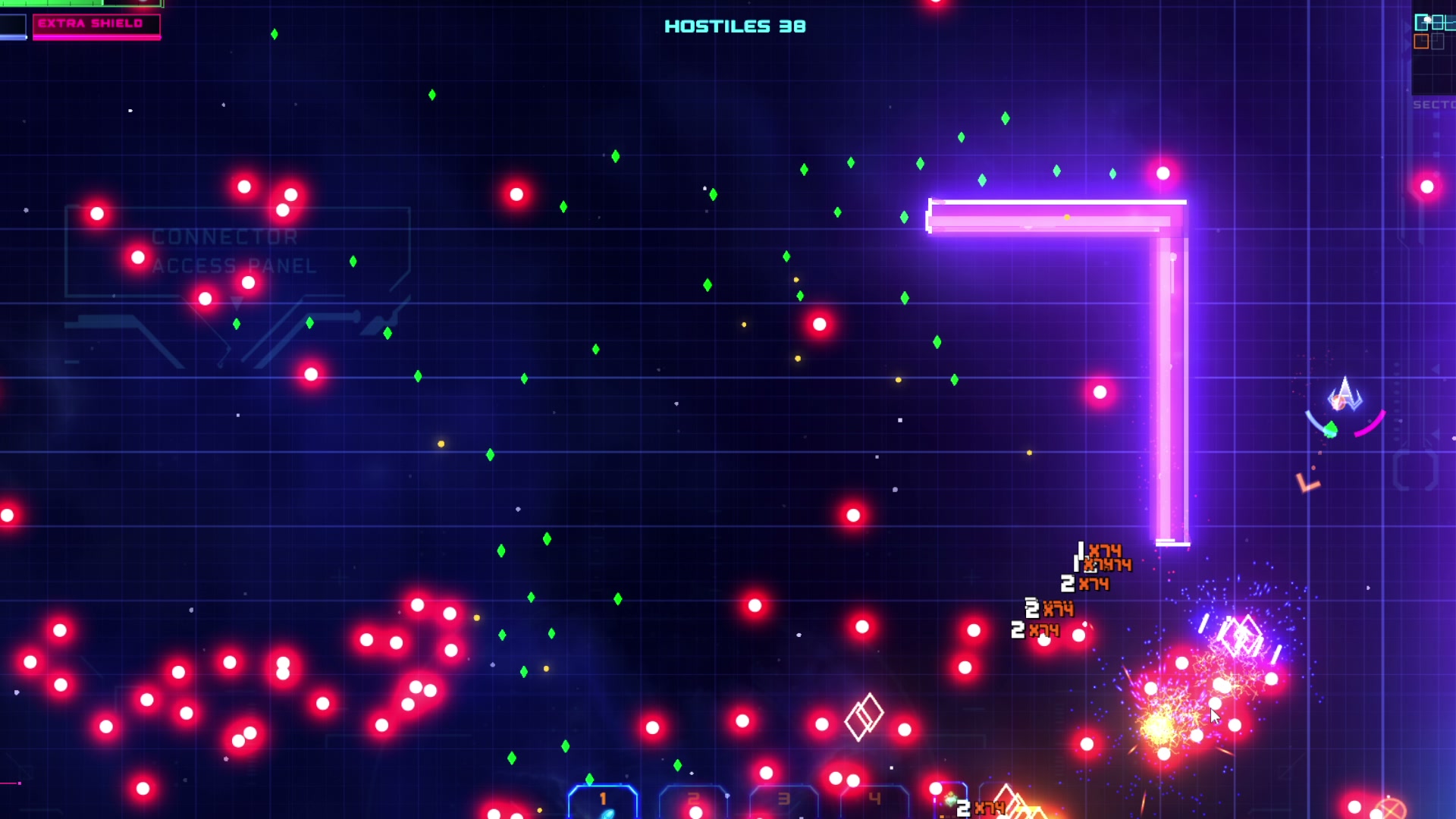
Álex's own philosophy covers it: "Just because something looks good doesn't mean it plays well. You have to test it when the screen is completely packed." On a packed screen, those tiny, fast projectiles are the part that needs another pass.
Controls
Tight handling, one awkward binding
The ship handles well. The controls are responsive, and I never felt the game was fighting me. I tried both assisted and manual aiming, as Álex recommends, and ended up preferring manual. Assisted aiming still felt mostly manual, and with full manual control I could push my fire in a chosen direction rather than have it drift off to the side.
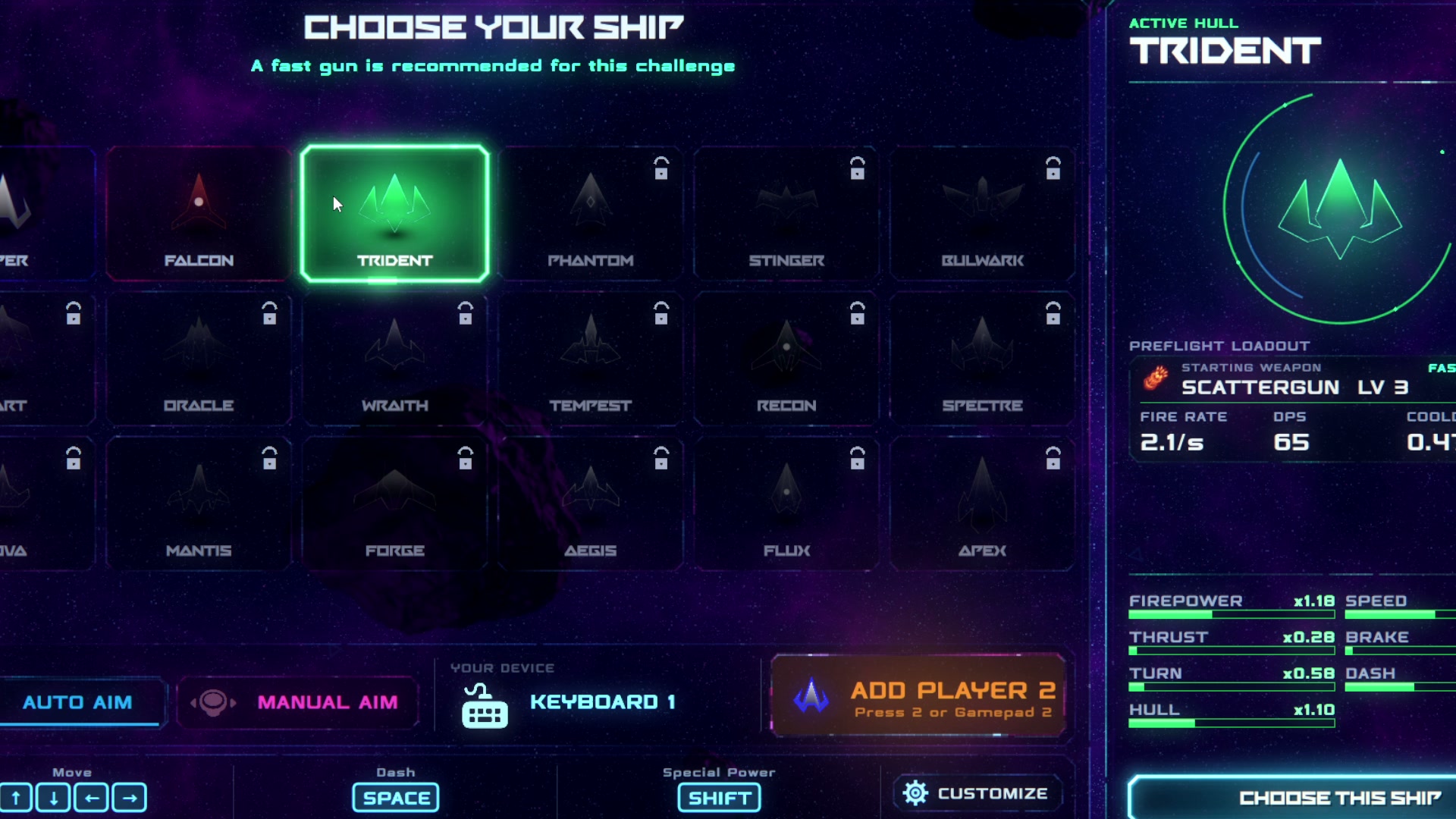
My one control complaint is the mouse bindings. Boost is on left click, and I kept wishing the shield were on right click, where my hand naturally wanted to find it.
Weapons and upgrades
Strong weapons shine, weaker ones struggle
I tried nearly every weapon, and they're not all equal. Some hit noticeably harder than others, and with the weaker ones it was hard to build a combination that worked. With the stronger weapons, though, the upgrade choices feel meaningful, and that matches what the developers are aiming for.
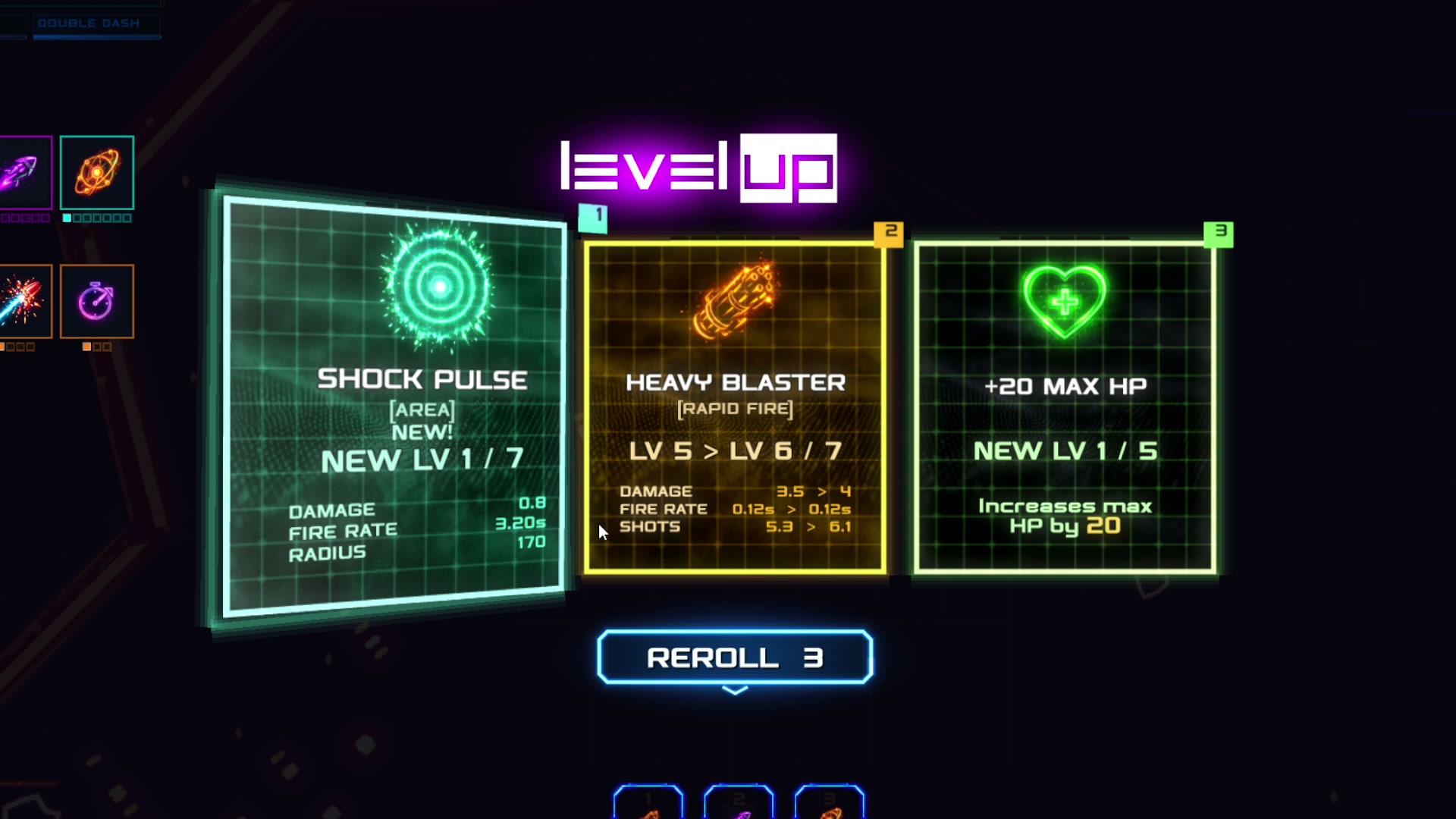
"An upgrade should do something you want to use, rather than just make a number bigger," Álex says. His favourite is Event Horizon: "having something like a lightsaber around your ship, clearing away everything that gets close." Víctor favours Resonance Nova: "being surrounded by a huge horde, exploding and watching it disappear all at once." I didn't come across either in my runs, which tells you how much there is to find.
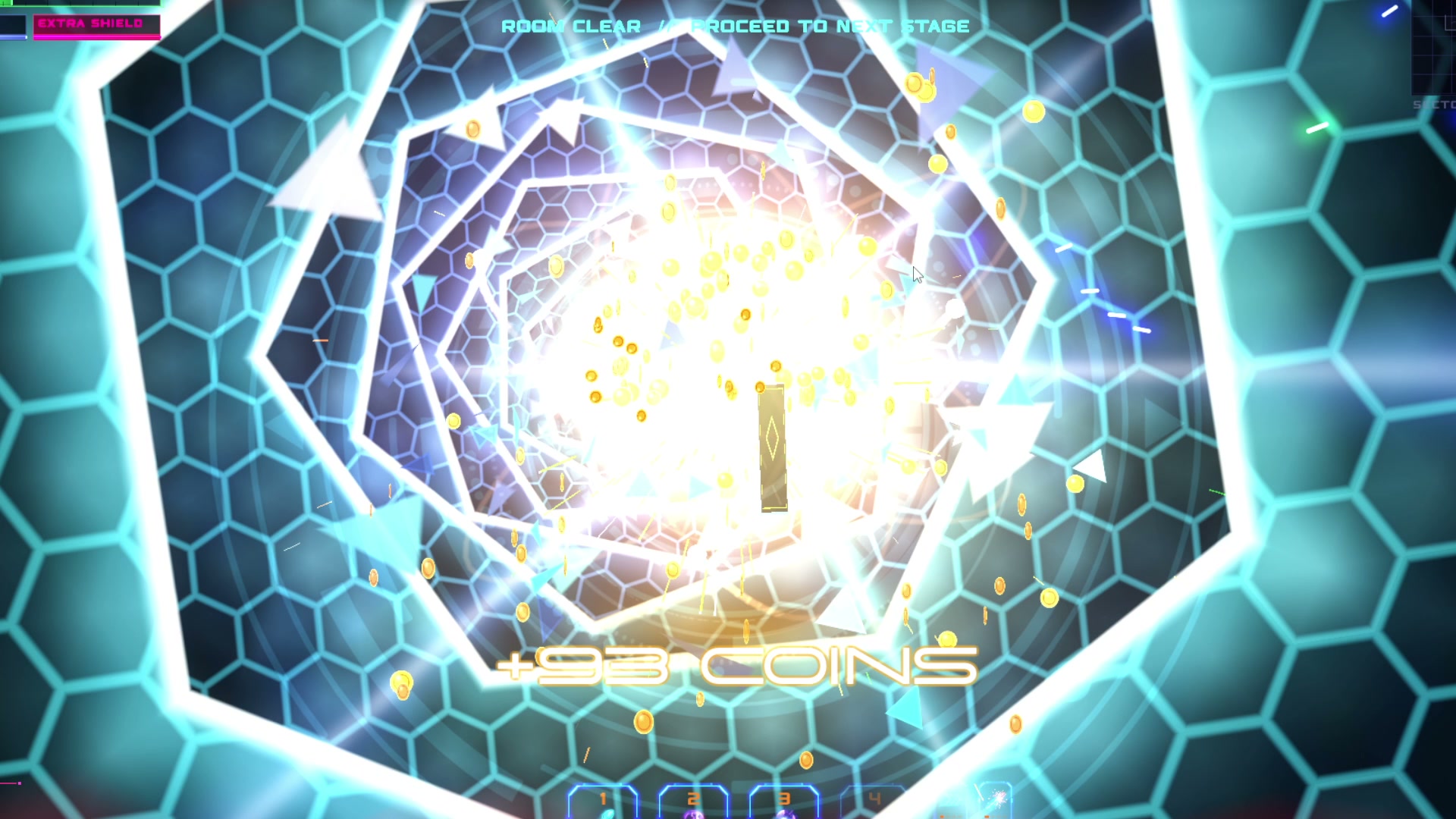
One upgrade did feel pointless: the pickup magnet for experience crystals. In challenge stages, every crystal is collected automatically when the stage ends, so the slot is mostly wasted. Removing or reworking it, at least in challenge mode, is an easy fix.
Ship variety is a real strength. The ships feel different from each other, and there are plenty to choose from.
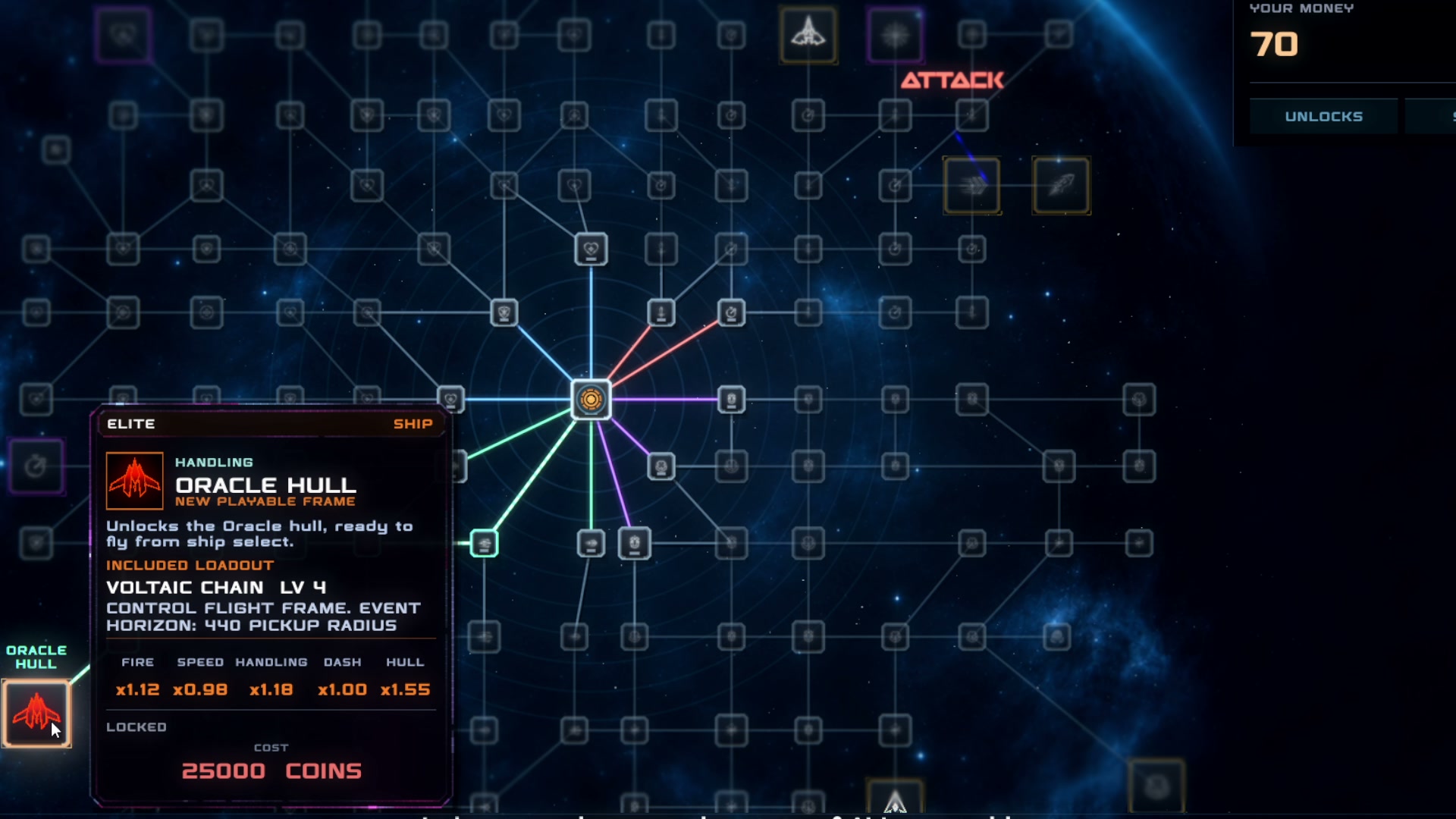
The meta-progression is also excellent. There are plenty of skills and abilities to unlock between runs, and it worked on me: a typical run took about 20 minutes, and I kept saying "one more" and played two or three extra runs.
Worlds and enemies
Where it gets unfair
"Above all, we don't want it to feel like the same screen with a different background," Víctor says of the game's four worlds. He also promises tributes to classic arcade games that players have been spotting.
My experience was more mixed. I reached the Void section of the game, and up to that point the stages felt quite similar: much the same arena, much the same style. To be fair, that's a real challenge for a game built on a minimalist geometric look, and the later worlds may change things up more. I didn't spot any of the arcade tributes along the way.
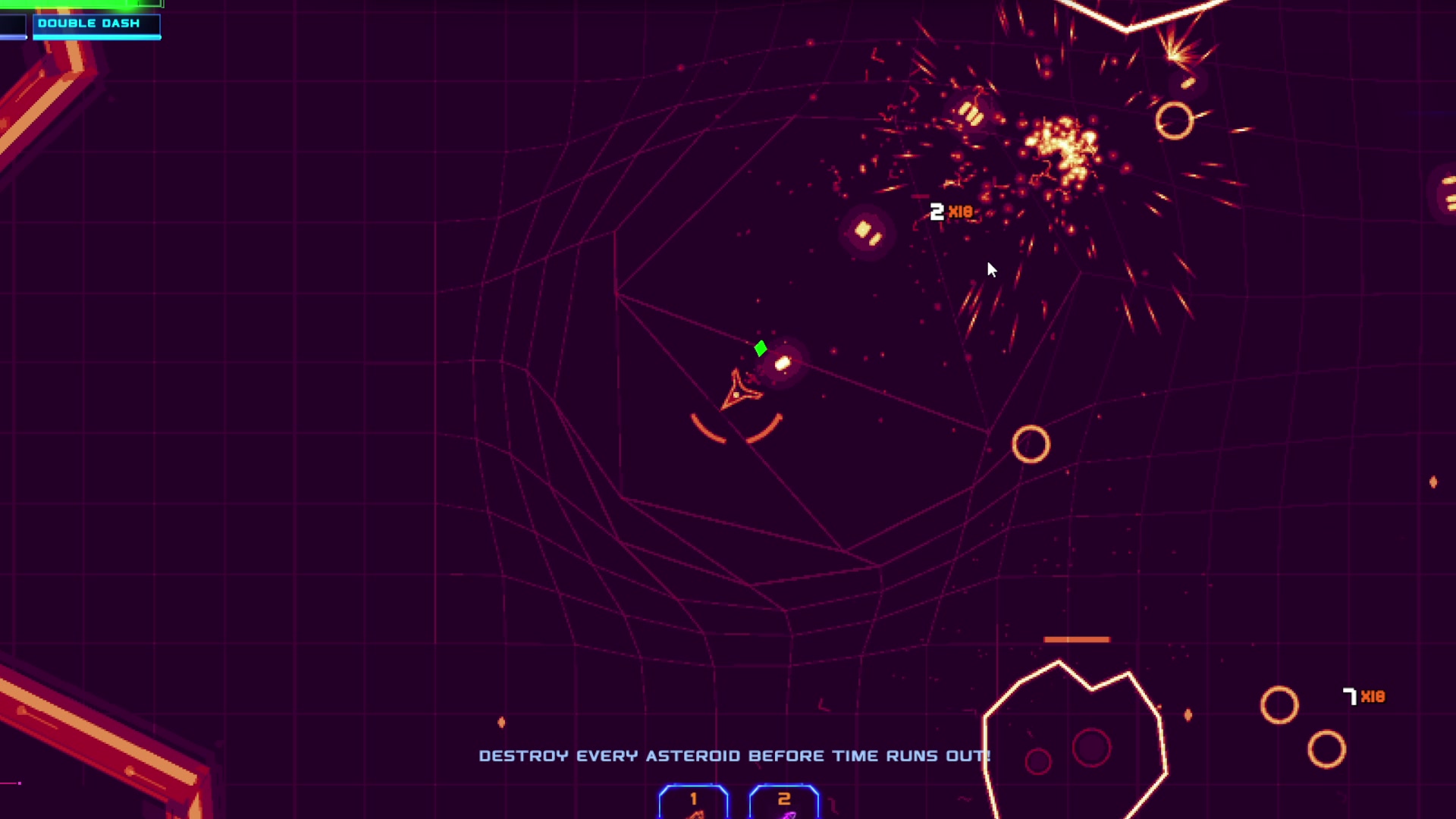
The enemy design is more interesting. Some enemies are genuinely creative, especially those with varied movement patterns that make you read and react. Others are the fast, tiny types that are hard to see. I'd rather those stayed fast but became bigger and more visible, so that when I die, it feels like my mistake rather than something I couldn't see.
I didn't run into a traditional boss in my time with the demo, but some challenge encounters fill a similar role, and one frustrated me. Turrets spawn on the side wall while a heavy stream of bullets comes down the screen. The turrets have a lot of health, so you spend most of the encounter dodging instead of attacking them. There are two of them, so after the first one dies the encounter gets easier, not harder, which feels backwards.
Álex described a similar moment from the other side: "We watched a YouTuber getting completely overwhelmed by a horde after choosing upgrades that weren't helping, and it made us see the game differently." It's encouraging that they're watching people play this closely.
If I could change one thing before launch, it would be enemies spawning on top of the player. Too often an enemy appeared right next to my ship and I lost health before I could react. A spawn exclusion radius, or a short telegraph before enemies appear, would remove the cheapest hits in the game. A few times I was also hit while dodging through enemies, even though I was fairly sure I'd timed the dodge correctly.
One smaller request: Arcade mode stays locked until you finish the campaign. I'd like access to it earlier, though I'll admit that may be because I hadn't beaten the campaign yet.
Co-op and music
Built to be played side by side, scored by a demoscene veteran
I played solo, but co-op is clearly the heart of the project for its creators. "We've finished so many games together and spent whole afternoons searching the PlayStation store for local co-op games," Víctor says. "We wanted other people to sit next to their child, a friend or their partner and share a game." Álex hopes players will end up "trying to beat that stubborn stage, trying something different and saying 'come on, one more.'"
Even playing alone, I can see it working. The game is easy to pick up, the runs are a good length, and the pull to keep going is strong.
The soundtrack fits the action perfectly and is one of the main reasons the game feels so immersive. That's no accident. Víctor composed under the alias Awesome in the demoscene, starting with trackers at 16, and with friends founded the group Wild Bits, whose early projects included a music disk of his tracks. The game's separate visual music player is, in his words, "a bit like doing that again, thirty years later." Today he composes the foundations in Reason or Logic Audio, then uses AI to help with part of the production and to make variations.
I was too busy chasing one more run to visit the music player. Based on what I heard in game, it's worth a look.
How it stacks up
Its own identity
Next to Geometry Wars and Vampire Survivors, Geometry Rift: Apocalypse holds up well. Vampire Survivors has more character in its art and a different flow to its play, but Geometry Rift has its own feel and its own identity. It draws clearly on its influences without coming across as a copy.
What surprised me most is how polished this is. It's a little-known game made by two people, and I expected it to be rough around the edges. Instead it plays smoothly, ran without a single bug or crash in my time with it, and shows real care in nearly every system.
The team says it's working on "final adjustments, balancing, and everything that comes up as we watch people play," and, having recently moved the game from Godot to Unity, it's checking the new version carefully ahead of a planned 2027 release. As for the ending, Álex isn't giving anything away: "I can't wait for people to get there, but we're not going to spoil the surprise, haha."
Playable demo: A free demo is available now on Steam. The store page is linked in the sources below.
The North Line verdict
Try the demo now
Geometry Rift: Apocalypse is for anyone who likes bullet hells and horde survivors, and for most people who like action games. It also looks like a natural fit for the Steam Deck. Players who hate cheap hits may get frustrated by tiny, fast projectiles and enemies that spawn on top of them, but those are fixable problems in a demo that is already polished and fun. I'll be playing the full release when it arrives, and I recommend trying the demo now.
What works
- Excellent soundtrack and consistent, polished presentation
- Responsive controls, with a choice of assisted or manual aiming
- Wide ship variety and rewarding meta-progression
- Strong "one more run" pull, with runs of about 20 minutes
- No bugs or crashes in my time with the demo
What holds it back
- Tiny, fast projectiles and enemies are hard to see in packed scenes
- Enemies can spawn directly on top of the player
- Some weapons are noticeably weaker than others
- The XP magnet upgrade is nearly useless in challenge stages
- The wall-turret challenge gets easier, not harder, as it goes on
- Arcade mode is locked until the campaign is finished
Based on the Steam demo, played solo on PC up to the Void. Co-op, the music player, the later worlds and the ending were not tested, and the final release may change.
- Geometry Rift: Apocalypse on Steam — Steam. Published: Date not listed. Supports: Demo availability, developers and publishers, local co-op, four worlds and planned 2027 release.
About the author

Able, Chief Editor
Able has spent six years reviewing games and following the stories around them. He focuses on what changed, what is worth a player’s time, and the context that gets lost in the announcement cycle.
Read this editor’s profile